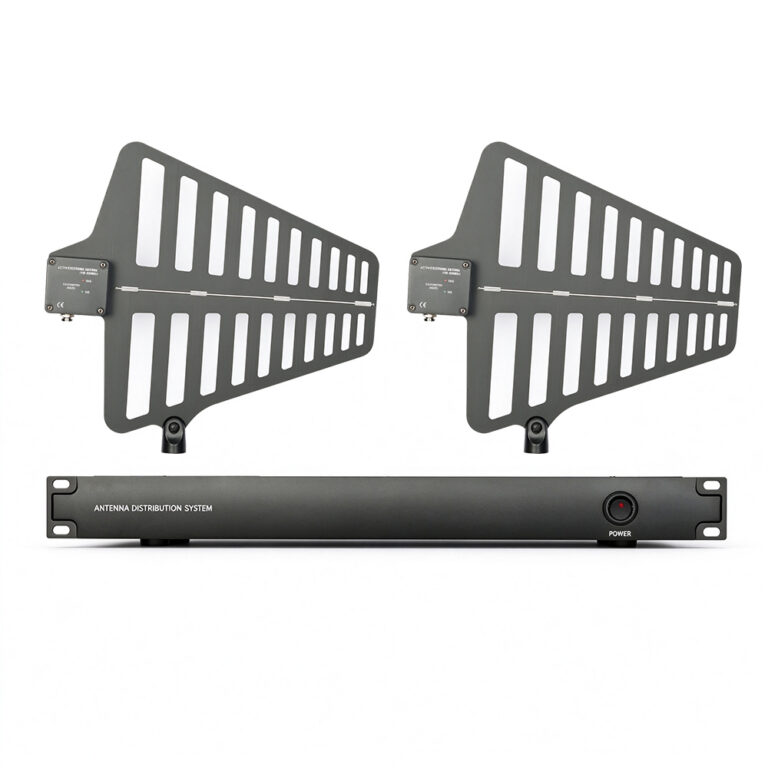
 Radio Frequency Signal Amplification System for Wireless Microphone
Home
/ Products
/ Wireless Stage Microphones
/ Wireless Microphone + RF Amplifier System Kit, Professional Stage Equipment
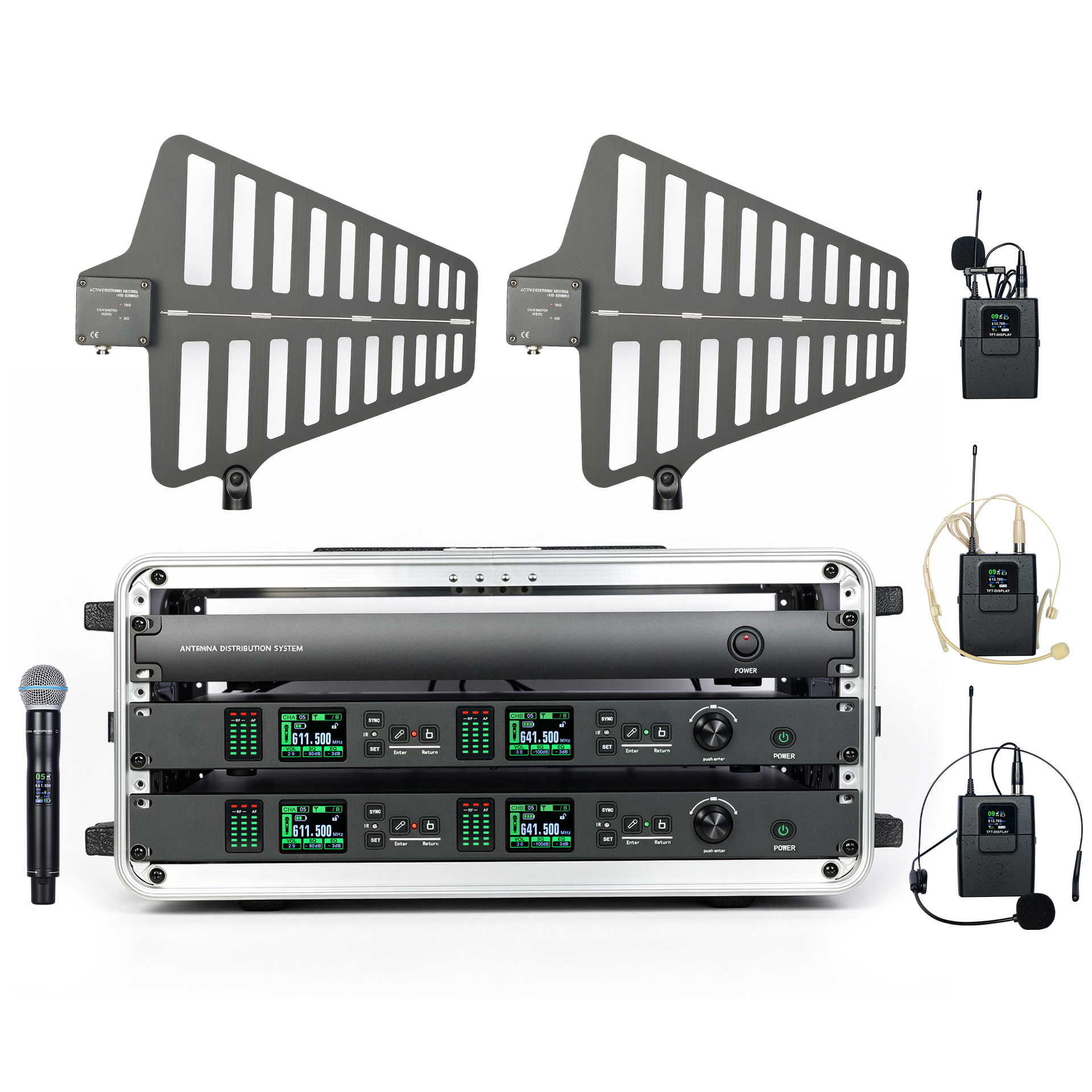
Wireless Microphone + RF Amplifier System Kit, Professional Stage Equipment
Antenna
Brief Description
This log-periodic dipole array provides optimal reception when aimed at the intended coverage area. The integrated amplifier features two gain settings to compensate for different levels of coaxial cable signal loss. The antenna can be mounted on a microphone stand, hung from the ceiling, or fixed to a wall with the integrated rotating bracket.
Features
- Low-noise signal amplifier compensates for insertion loss of coaxial cables
- Compatible with wireless receivers and antenna distribution systems that supply 10–15 V DC
- Integrated threaded bracket allows easy mounting onto microphone stands
- High quality, high reliability and durability
Installation
- Connect the antenna to the receiver or distribution system using antenna cable (or any 50-ohm low-loss coaxial cable).
- The antenna shall only be used with receivers or distribution systems that provide 10–15 V DC power.
- Reduce the gain setting for short cables; increase the gain setting for long cables. Please note that signal loss depends on both cable quality and cable length.
- A lightweight 50-foot cable may require higher gain than a 100-foot low-loss cable.
- Aim the antenna toward the coverage area.
Antenna Placement
Observe the following points when fixing the antenna:
- The antenna and receiver must operate on the same frequency band.
- Mount antennas at least four feet apart from each other.
- Adjust antenna position so that the transmitter has a clear line of sight without obstacles (including audience).
- Keep the antenna away from large metal objects.
Important Note: Before the wireless system is used for speeches or performances, perform a walk test to check signal coverage. Test different antenna positions to find the optimal placement. Mark dead spots according to actual conditions and remind speakers or performers to avoid these areas.
Gain Setting
Gain is only intended to compensate for calculated cable signal loss. Higher gain does not deliver better RF performance. Excessive gain will actually reduce reception range and available channels. The receiver achieves optimum performance when the sum of signal gain and cable loss equals 0 dB. Higher gain amplifies all signals within the frequency band, including interference and ambient RF noise. It cannot selectively boost the transmitter signal.
- Based on the RF indicator or level meter reading on the receiver, use the lowest gain setting that achieves good RF reception of the transmitter.
- If the antenna RF Overload indicator lights up, reduce the gain.
- For applications with cable length ≤ 6 m and distance between transmitter and antenna less than 30 m, use the 3 dB gain setting.
- Recommended Gain Settings
Note: For installations where the distance between antenna and transmitter is less than 30 m, reduce the gain setting by one level.
G2:
-
Wireless Microphone System for Stage Performance, Best Quality, True Diversity 300m
Product Parameters:
1:All products in the series feature a full-color high-definition 2.0-inch TFT display
2:Utilizing advanced digital pilot technology, independent ID codes, stable PLL phase-locked oscillator circuits,
and "noise detection" mute control,
3:True quad-channel antenna diversity with single-channel AB smart switching for signal reception
4:Equipped with a 5-band adjustable equalizer for pitch correction and 30-step fine audio gain output
5:One-button full-frequency radar scanning to obtain pure frequency points and
achieve fully automatic infrared frequency matching;
6: The host can store 2 frequencies per channel and enables seamless intelligent switching between lavalier,
handheld, and conference microphones with a single button press
7: This handheld microphone features a 0.96-inch TFT screen design, with 9-level gain adjustment,
high/low power switching, and a lock button
8:Reference working range: 200-300 meters (specific working range determined based on on-site conditions).
Product Parameters:
1:All products in the series feature a full-color high-definition 2.0-inch TFT display
2:Utilizing advanced digital pilot technology, independent ID codes, stable PLL phase-locked oscillator circuits, and "noise detection" mute control,
3:True quad-channel antenna diversity with single-channel AB smart switching for signal reception
4:Equipped with a 5-band adjustable equalizer for pitch correction and 30-step fine audio gain output
5:One-button full-frequency radar scanning to obtain pure frequency points and achieve fully automatic infrared frequency matching;
6: The host can store 2 frequencies per channel and enables seamless intelligent switching between lavalier,
handheld, and conference microphones with a single button press
7: This handheld microphone features a 0.96-inch TFT screen design, with 9-level gain adjustment, high/low power switching, and a lock button
8:Reference working range: 200-300 meters (specific working range determined based on on-site conditions).
Technical Specifications:
Antenna
Brief Description
This log-periodic dipole array provides optimal reception when aimed at the intended coverage area. The integrated amplifier features two gain settings to compensate for different levels of coaxial cable signal loss. The antenna can be mounted on a microphone stand, hung from the ceiling, or fixed to a wall with the integrated rotating bracket.
Features
- Low-noise signal amplifier compensates for insertion loss of coaxial cables
- Compatible with wireless receivers and antenna distribution systems that supply 10–15 V DC
- Integrated threaded bracket allows easy mounting onto microphone stands
- High quality, high reliability and durability
Installation
- Connect the antenna to the receiver or distribution system using antenna cable (or any 50-ohm low-loss coaxial cable).
- The antenna shall only be used with receivers or distribution systems that provide 10–15 V DC power.
- Reduce the gain setting for short cables; increase the gain setting for long cables. Please note that signal loss depends on both cable quality and cable length.
- A lightweight 50-foot cable may require higher gain than a 100-foot low-loss cable.
- Aim the antenna toward the coverage area.
Antenna Placement
Observe the following points when fixing the antenna:
- The antenna and receiver must operate on the same frequency band.
- Mount antennas at least four feet apart from each other.
- Adjust antenna position so that the transmitter has a clear line of sight without obstacles (including audience).
- Keep the antenna away from large metal objects.
Important Note: Before the wireless system is used for speeches or performances, perform a walk test to check signal coverage. Test different antenna positions to find the optimal placement. Mark dead spots according to actual conditions and remind speakers or performers to avoid these areas.
Gain Setting
Gain is only intended to compensate for calculated cable signal loss. Higher gain does not deliver better RF performance. Excessive gain will actually reduce reception range and available channels. The receiver achieves optimum performance when the sum of signal gain and cable loss equals 0 dB. Higher gain amplifies all signals within the frequency band, including interference and ambient RF noise. It cannot selectively boost the transmitter signal.
- Based on the RF indicator or level meter reading on the receiver, use the lowest gain setting that achieves good RF reception of the transmitter.
- If the antenna RF Overload indicator lights up, reduce the gain.
- For applications with cable length ≤ 6 m and distance between transmitter and antenna less than 30 m, use the 3 dB gain setting.
- Recommended Gain Settings
Note: For installations where the distance between antenna and transmitter is less than 30 m, reduce the gain setting by one level.
Specifications
- Frequency Range: 400 MHz–950 MHz
- Reception Angle: 70°
- Gain: Built-in 3 dB / 10 dB adjustable
- Connector: BNC
- Impedance: 50 Ω
- Voltage: 9–12 V
- Dimensions: 360×330×35 mm
Directional Antenna (External 31-level adjustable gain)
Specifications
- Frequency Range: 400 MHz–950 MHz
- Reception Angle: 70°
- Gain: External 0 dB ~ +31 dB adjustable
- Connector: BNC
- Impedance: 50 Ω
- Voltage: 9–12 V
- Dimensions: 360×330×35 mm
G2:
-
Wireless Microphone System for Stage Performance, Best Quality, True Diversity 300m
Product Parameters:
1:All products in the series feature a full-color high-definition 2.0-inch TFT display
2:Utilizing advanced digital pilot technology, independent ID codes, stable PLL phase-locked oscillator circuits,
and "noise detection" mute control,
3:True quad-channel antenna diversity with single-channel AB smart switching for signal reception
4:Equipped with a 5-band adjustable equalizer for pitch correction and 30-step fine audio gain output
5:One-button full-frequency radar scanning to obtain pure frequency points and
achieve fully automatic infrared frequency matching;
6: The host can store 2 frequencies per channel and enables seamless intelligent switching between lavalier,
handheld, and conference microphones with a single button press
7: This handheld microphone features a 0.96-inch TFT screen design, with 9-level gain adjustment,
high/low power switching, and a lock button
8:Reference working range: 200-300 meters (specific working range determined based on on-site conditions).
Product Parameters:
1:All products in the series feature a full-color high-definition 2.0-inch TFT display
2:Utilizing advanced digital pilot technology, independent ID codes, stable PLL phase-locked oscillator circuits, and "noise detection" mute control,
3:True quad-channel antenna diversity with single-channel AB smart switching for signal reception
4:Equipped with a 5-band adjustable equalizer for pitch correction and 30-step fine audio gain output
5:One-button full-frequency radar scanning to obtain pure frequency points and achieve fully automatic infrared frequency matching;
6: The host can store 2 frequencies per channel and enables seamless intelligent switching between lavalier,
handheld, and conference microphones with a single button press
7: This handheld microphone features a 0.96-inch TFT screen design, with 9-level gain adjustment, high/low power switching, and a lock button
8:Reference working range: 200-300 meters (specific working range determined based on on-site conditions).
Technical Specifications:
Receiver:
Frequency range: 615 -- 665MHz (produced according to company standards)
Oscillation Mode: Phase-Locked Loop (PLL) Frequency Synthesis
Reception method: The primary frequency conversion employs super heterodyne,
while the secondary frequency conversion adopts super heterodyne as well
Adjustable channel count: 200 adjustable frequency points
Frequency stability: ±0.002 PPM
Receive sensitivity: -100dBm
Maximum frequency deviation: ±70KHz
Spurious suppression: ≥70dB
Audio response range: 40~18000Hz
Distortion degree: ≤0.5%,
Signal-to-noise ratio: ≥113dB
Audio Output: (XLR) XLR jack for independent balanced output and
Φ6.35 socket for mixed unbalanced output
Power supply specifications: DC 12~18 volts / 50~60 Hz / 1000 milliamps
Power consumption: ≤10W
Transmitter:
Frequency range: 615--665 MHz
Maximum channel count: 200
Modulation method: FM (Frequency Modulation)
Output power: 5 mW/30 mW
Subharmonic suppression: > -60dB
Frequency bandwidth: 50 MHz
Maximum modulation depth: ±60kHz
Input voltage range: Microphone up to 1V
Distortion: ≤0.5%
Battery: 2 pieces of 1.5V (AA)
Battery life: 6-10 hours
No reviews yet. Be the first to review this product.
You may also like
Radio Frequency Signal Amplification System for Wireless Microphone
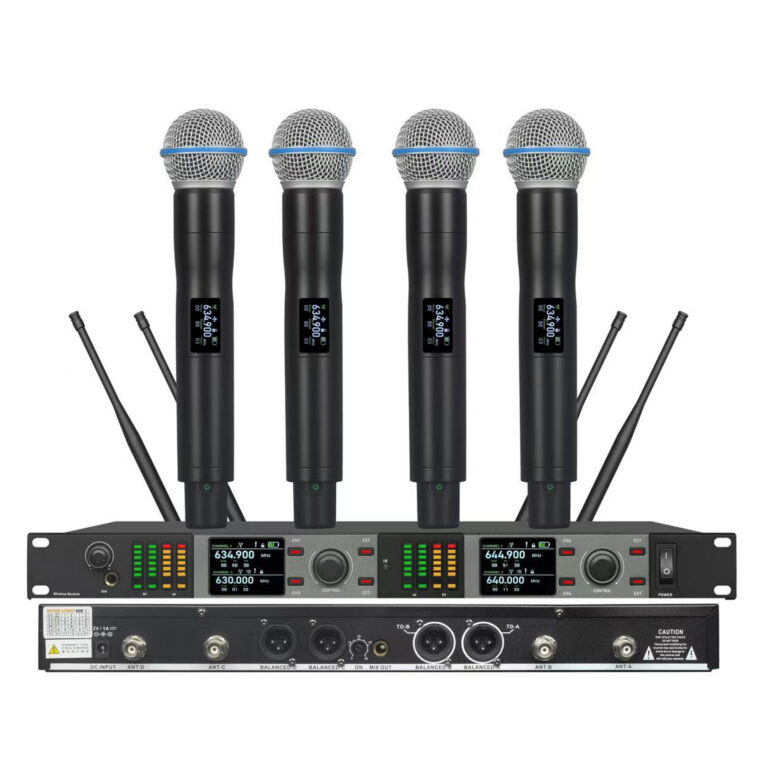 G24-4 Wireless Microphone System 4 Channel for Stage Performance
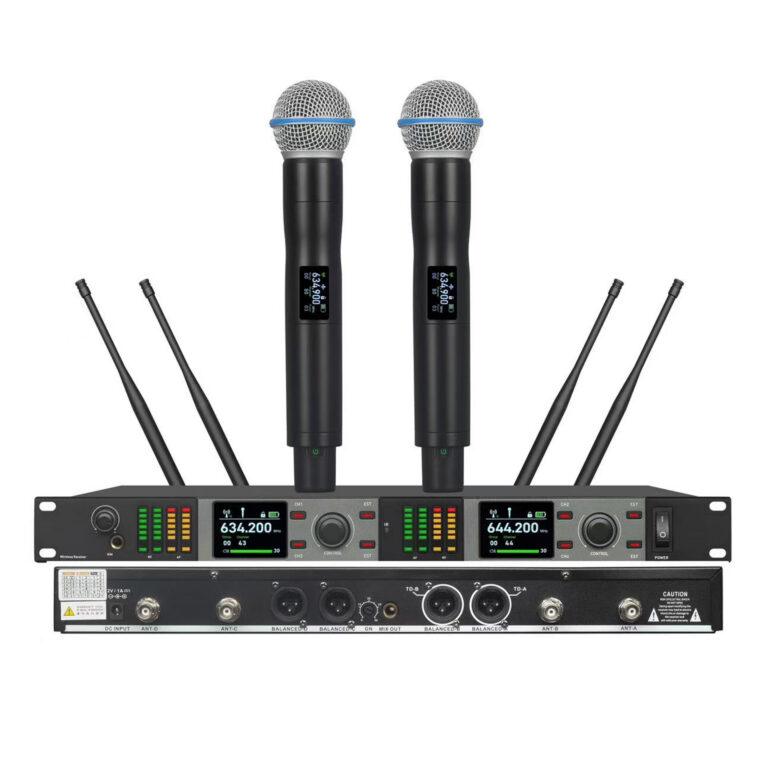 G24-2 Wireless Microphone System 2 Channel for Stage Performance
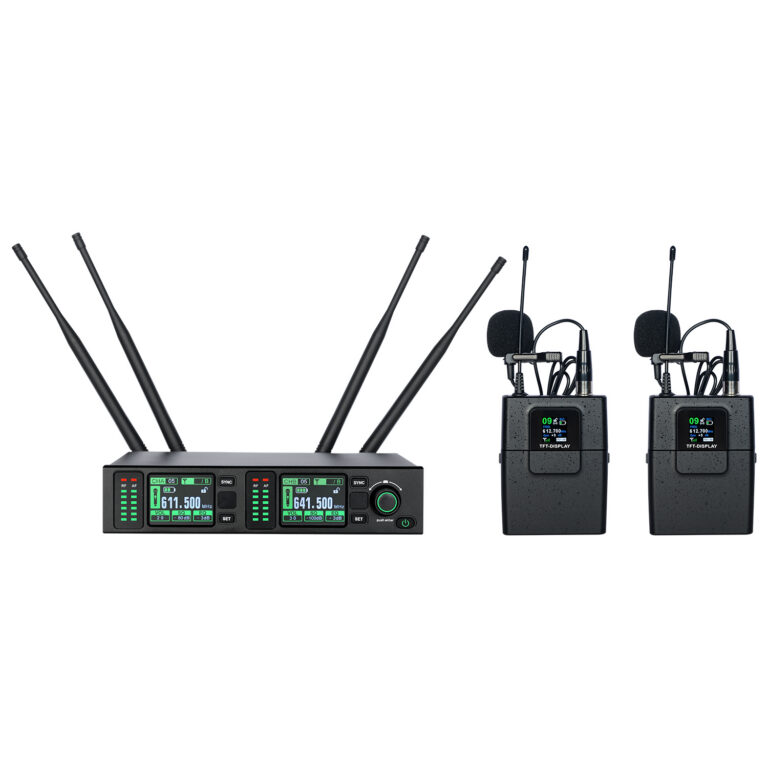 G2 Lavalier Wireless Microphone System for Stage Performance
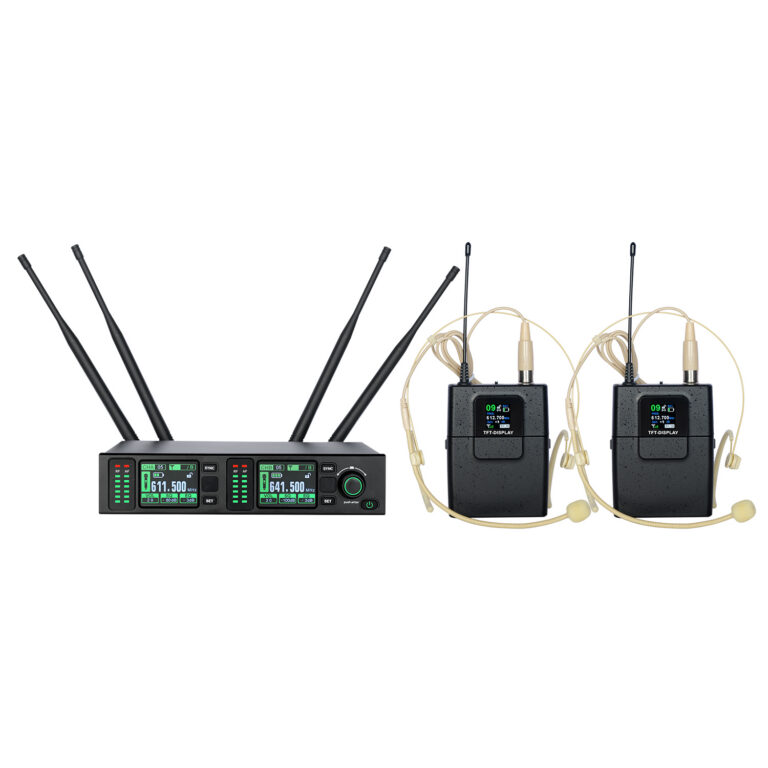 G2 Skin-colored over-ear headset Wireless Microphone System for Stage Performance